As an Amazon Associate, I earn from qualifying purchases at no extra cost to you.
6 Best Damascus Chef Knife Picks (Buying Guide) 2026
 ByZayyan

If you’ve ever used a dull, cheap knife in the kitchen, you know the frustration. You’re trying to slice a tomato and it’s basically just smooshing it. In this article I will show you the top 6 best Damascus chef knife options that actually cut like they mean it, so you can cook faster, safer, and with way more confidence.


Top 6 Best Damascus Chef Knives You Can Buy Now
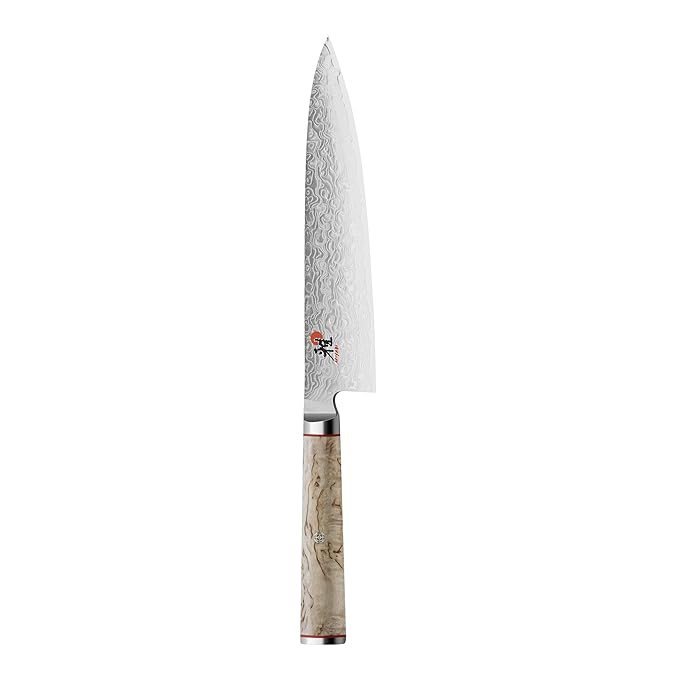
Miyabi Birchwood SG2 Japanese Chef’s Knife – Best for Serious Home Cooks
This knife is something else. Miyabi is a Japanese brand with a reputation that speaks for itself, and the Birchwood SG2 lives up to every bit of it. The blade is made from SG2 micro-carbide powder steel, wrapped in 100 layers of Damascus steel. That’s not just for looks. All those layers give you a blade that holds its edge for a really long time.
The handle is Karelian birchwood, which feels warm and natural in your hand. Not slippery. Not too heavy. It just feels right. The knife is hand-sharpened to a 9.5 to 12 degree angle on each side, which is sharper than most Western knives you’ll find. That means cleaner cuts, less effort, and food that actually looks good on the plate.
Yes, this one costs more than the others on this list. But if you cook regularly and want a knife that feels like a joy to use, not just a tool, the Miyabi Birchwood is worth every penny. It’s the kind of knife you pass down.
Quick Highlights:
- SG2 micro-carbide steel core for incredible sharpness
- 100-layer Damascus pattern
- Karelian birchwood handle, beautiful and grippy
- Hand-sharpened to 9.5-12 degrees per side
- Premium pick, but worth it for serious cooks
SHAN ZU Chef Knife 8 Inch Damascus Kitchen Knife – Best Budget Damascus Pick
SHAN ZU punches way above its price. For a Damascus knife that won’t break the bank, this one is hard to beat. The blade uses a Japanese AUS-10 steel core with 67 layers of Damascus folded around it. AUS-10 is solid steel. It holds an edge well and doesn’t chip easily under normal kitchen use.
The blade comes razor sharp out of the box. Most people are surprised by that. You can slice paper-thin cuts of onion, glide through raw chicken, or break down a butternut squash without much effort. The G10 handle is tough, water-resistant, and feels solid whether your hands are wet or dry.
One thing to watch out for: don’t throw this in the dishwasher. Damascus knives need hand washing. It only takes 30 seconds and it’ll keep your blade looking great for years. SHAN ZU even includes a cleaning cloth, which is a nice touch.
If you want the Damascus experience without spending a lot, start here. It’s a genuinely good knife at a fair price.
Quick Highlights:
- AUS-10 steel core with 67-layer Damascus
- Sharp right out of the box
- G10 handle, water-resistant and grippy
- Hand wash only, easy to maintain
- Great value for the price
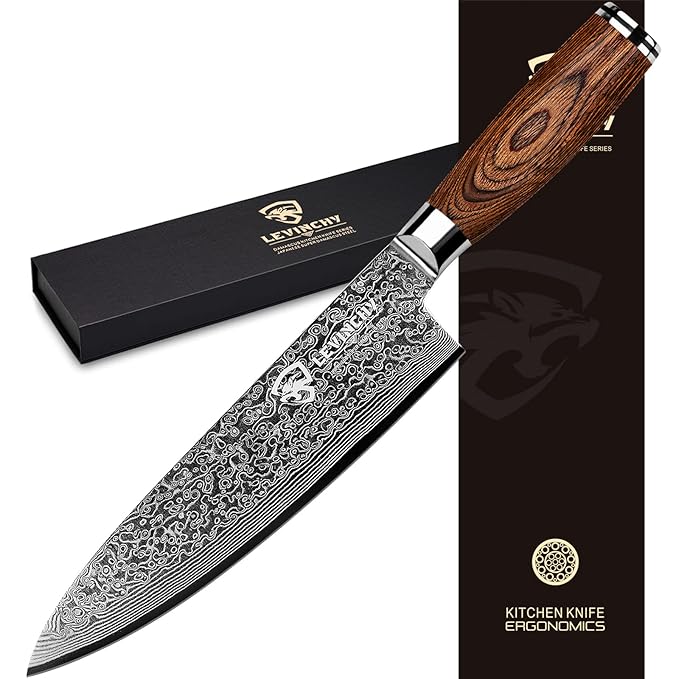
Damascus Chef’s Knife 8 Inch – Best for Everyday Kitchen Use
Sometimes you don’t need the fanciest knife. You just need one that works well every single day without making you worry about it. This 8-inch Damascus chef knife hits that spot perfectly. It’s built for practical use and it delivers on that promise consistently.
The blade uses high-carbon stainless steel that’s corrosion-resistant. That matters if you live somewhere humid or if you cook with a lot of acidic ingredients like citrus or tomatoes. The edge retention is solid. You won’t need to sharpen it every week. A good honing steel every few uses keeps it performing well between sharpenings.
The handle is ergonomic and balanced. It doesn’t feel top-heavy or awkward. Chop vegetables for 20 minutes and your hand won’t feel tired. That balance makes a bigger difference than most people expect before they try it.
It’s not the flashiest option. But it’s reliable, well-built, and priced fairly for what you get. Sometimes that’s exactly what you need.
Quick Highlights:
- High-carbon stainless steel, corrosion-resistant
- Good edge retention for daily cooking
- Ergonomic, well-balanced handle
- Works well with acidic foods and humid conditions
- Reliable and practical everyday choice
Sunnecko 8 Inch Japanese Damascus Chef Knife – Best for Comfortable Grip
A lot of people overlook how important the handle is. You can have the sharpest blade in the world, but if the handle feels awkward, cooking becomes a chore. Sunnecko gets this. Their 8-inch Damascus chef knife has a pakkawood handle that fits naturally in your hand, whether you grip it tight or hold it loosely toward the blade.
The blade core is Japanese VG10 steel, which is known for holding a sharp edge under regular use. It’s wrapped in layers of Damascus steel that give it that flowing, wavy pattern. Not just pretty. Those layers actually add strength and a bit of flexibility to the blade.
The knife comes with a full tang construction, meaning the steel runs all the way through the handle. That makes it more durable and gives it better balance overall. You can feel that solidity when you hold it.
This one is a great pick if you’ve had grip issues with knives before, or if you just spend a lot of time in the kitchen and want something that feels comfortable from minute one to minute sixty.
Quick Highlights:
- VG10 steel core wrapped in Damascus layers
- Pakkawood handle, natural and comfortable
- Full tang for balance and durability
- Great for long cooking sessions
- Solid choice for comfort-focused cooks
KYOKU 8 Inch Chef Knife – Best for Style Plus Performance
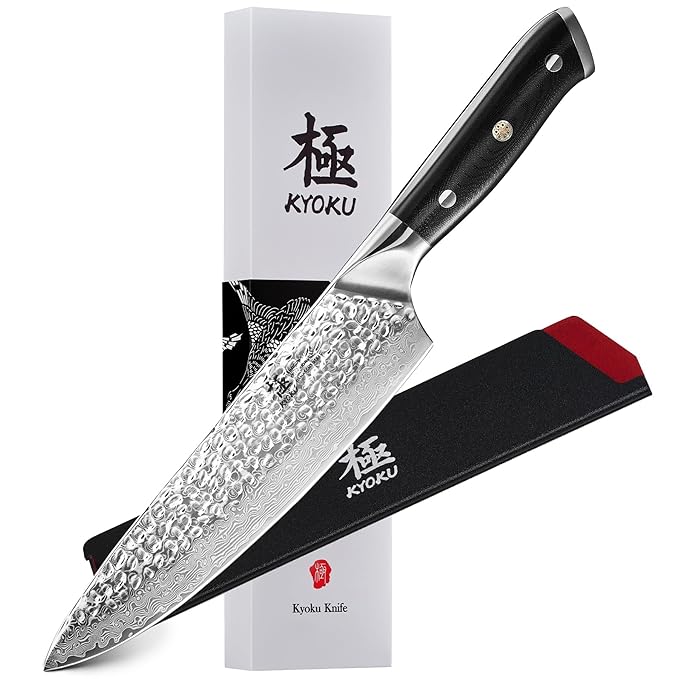
KYOKU makes knives that look amazing and actually back it up with solid performance. The 8-inch Damascus chef knife has a gorgeous blade pattern and comes with a sheath, which is a practical bonus most knives in this range don’t include. That sheath makes it easy to store safely in a drawer without dulling the edge.
The steel is Japanese 67-layer Damascus with a VG10 core. Same premium steel you’ll find in knives costing twice as much. The edge is hand-finished to around 8 to 10 degrees per side, making it one of the sharper options on this list. It glides through food with minimal pressure, which saves your wrist over a long cooking session.
The handle uses pakkawood with a mosaic pin detail. It looks premium, and it feels premium too. Balanced, comfortable, and not too heavy. KYOKU includes a sheath and a finger guard as well, which shows they actually thought about the full user experience.
If you want a knife that impresses on the counter and in the kitchen, KYOKU delivers both without charging you a ridiculous amount.
Quick Highlights:
- 67-layer Damascus with VG10 core
- Sharpened to 8-10 degrees for extra precision
- Comes with a protective sheath
- Pakkawood handle with mosaic detail
- Stylish AND high-performing
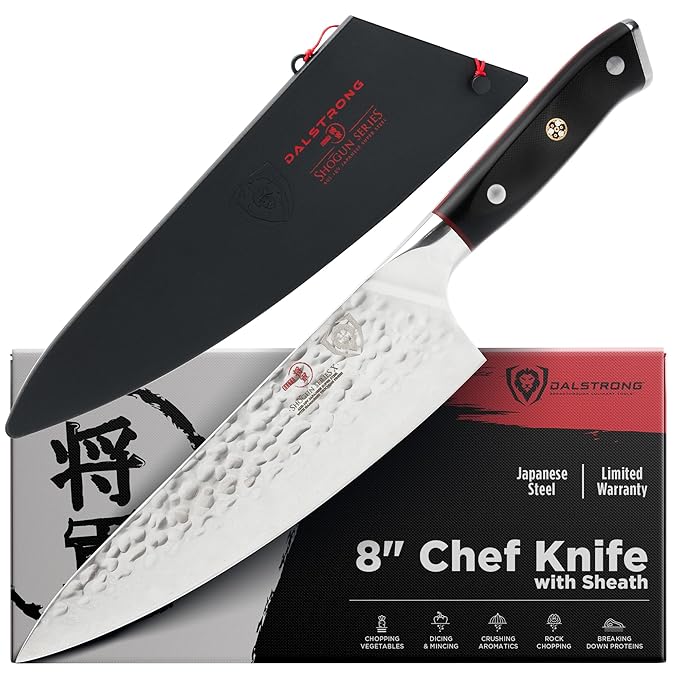
Dalstrong 8 Inch Japanese Chef Knife – Best Brand with a Cult Following
Dalstrong has built a massive fanbase and for good reason. Their knives look incredible, feel great, and perform at a level that surprises a lot of people when they first use one. The Shogun Series 8-inch Damascus chef knife is one of their most popular, and it earns that reputation every time you pick it up.
The blade uses AUS-10V super steel at the core with 67 layers of high-carbon Damascus cladding. Dalstrong also uses a cryogenic tempering process on the steel, where the blade is treated at extreme cold to increase its hardness and edge retention. It sounds technical, but what it means for you is a blade that stays sharp longer between sharpenings.
The handle is G10 Garolite, military-grade material. It’s tough, won’t absorb moisture, and holds up through years of daily use. The knife also comes in a beautiful box, which makes it a great gift if you’re buying for someone else.
Dalstrong offers a strong warranty and responsive customer service, which gives you extra peace of mind. It’s a brand you can trust.
Quick Highlights:
- AUS-10V steel with cryogenic tempering
- 67-layer Damascus cladding
- G10 military-grade handle
- Comes in premium packaging, great as a gift
- Strong warranty and solid customer support
I hope this guide helped you figure out which Damascus chef knife is the right fit for your kitchen. If budget isn’t a concern, go Miyabi. Want value? SHAN ZU or KYOKU. Need comfort? Try Sunnecko. Want a trusted brand with a big community behind it? Dalstrong won’t let you down. Whatever you pick, a good knife makes cooking feel easier and way more enjoyable.
| Knife | Steel Core | Layers | Best For |
|---|---|---|---|
| Miyabi Birchwood SG2 | SG2 Micro-Carbide | 100 | Serious home cooks, premium pick |
| SHAN ZU Damascus 8″ | AUS-10 | 67 | Budget buyers, beginners |
| Damascus Chef Knife 8″ | High-Carbon Stainless | Damascus clad | Everyday cooking, reliability |
| Sunnecko Japanese Damascus | VG10 | Multi-layer | Comfort-focused, long sessions |
| KYOKU 8″ Chef Knife | VG10 | 67 | Style + performance, gifts |
| Dalstrong Shogun 8″ | AUS-10V | 67 | Brand trust, longevity |
Things to Consider Before Buying a Damascus Chef Knife (Complete Guide)
Buying a Damascus chef knife feels exciting. The wavy blade patterns look incredible, the steel feels serious, and the whole thing just feels like an upgrade. But a lot of people buy one based on looks alone and end up disappointed.
There are real things to consider before buying a Damascus chef knife that most sellers won’t tell you upfront. Steel quality, handle fit, weight, edge angle, and how you actually cook all matter more than the pretty pattern on the blade. Get these right and you’ll love your knife for years.
Steel Core Quality
The Damascus pattern is the first thing you notice. But the steel underneath that pattern is what actually matters. Most Damascus knives have a core steel wrapped in layers of softer steel. That core does all the cutting work, so it needs to be good.
Japanese steel like VG10, AUS-10, or SG2 are the ones worth looking for. These hold an edge well, resist chipping, and don’t need constant sharpening. If a knife listing doesn’t tell you what the core steel is, that’s a red flag. Cheap knives hide this on purpose.
Watch out for vague terms like “high-carbon Damascus steel” with no specific steel name. That usually means lower-quality material dressed up in marketing. A real quality knife will always tell you exactly what steel it uses.
- Look for named steel: VG10, AUS-10, AUS-8, SG2
- More layers (67 or 100) usually means better build quality
- If the listing doesn’t name the steel, skip it
- Hard steel (HRC 60+) holds an edge longer
Handle Comfort and Grip
A sharp blade is useless if the handle makes your hand tired after ten minutes. The handle is what connects you to the knife. And yet most buyers spend 90% of their research time on the blade.
Try to think about how you hold a knife. Do you use a pinch grip, where your thumb and index finger hold the actual blade near the handle? Or do you wrap your whole hand around the handle? Different handle shapes suit different grips. Octagonal handles feel great for pinch grippers. Classic western bolster styles work well for full-handle grippers.
Material matters too. Pakkawood is a popular choice because it’s comfortable, water-resistant, and doesn’t slip when wet. G10 is even tougher and feels very secure. Avoid handles made from cheap plastic, they crack over time and feel hollow.
- Pakkawood and G10 are the best handle materials
- Full tang (steel running through the whole handle) adds balance and durability
- Test the weight distribution, it should feel balanced at the pinch point
- Avoid handles that feel too light or too plasticky
Blade Length and Weight
Most Damascus chef knives come in 8 inches, which works well for most people. But not everyone. If you have smaller hands or a cramped kitchen counter, a 6-inch knife might actually suit you better. If you’re breaking down large cuts of meat regularly, a 10-inch gives you more clearance.
Weight is just as personal. Japanese-style knives are usually lighter with thinner blades. German-style knives are heavier with more heft behind each cut. Neither is wrong. It depends on your style. If you like precision and thin cuts, go lighter. If you like push-cutting through dense vegetables, a heavier knife gives you more momentum.
One practical test: hold the knife at the pinch point and see if the tip dips down or stays level. A well-balanced knife stays almost level. A poorly balanced one feels like it’s pulling your wrist forward. That gets tiring fast.
- 8 inches works for most home cooks
- Lighter knives suit detail work, heavier ones suit power cuts
- Balance matters more than raw weight
- Try holding it before buying if you can
Edge Angle and Sharpness
Damascus knives from Japanese brands are usually sharpened to around 15 degrees per side or less. Western knives sit closer to 20 to 25 degrees. The lower the angle, the sharper the edge, but also the more delicate it is. A 10-degree edge cuts beautifully but chips if you use it on hard bones.
Knowing your edge angle matters because it affects how you sharpen the knife later. If you sharpen a 15-degree Japanese edge with a pull-through sharpener set for 20 degrees, you’re changing the geometry of the blade over time. That’s a slow way to ruin a good knife.
Most quality Damascus knives tell you the edge angle in the product description. If yours doesn’t, check the brand’s website or contact them directly. It’s a small detail that saves you a lot of headaches down the road.
- Japanese edges: 10-15 degrees per side, very sharp, more delicate
- Western edges: 20-25 degrees per side, tougher, more forgiving
- Match your sharpener to your knife’s angle
- Single bevel knives (one side only) need special sharpening technique
Maintenance and Care Requirements
A Damascus knife is not a set-it-and-forget-it tool. It needs regular care. And that’s not a complaint, it’s just the reality of owning a quality blade. The good news is that care is simple once you build the habit.
Hand washing is non-negotiable. Dishwashers use harsh detergent, high heat, and water pressure that strips the finish, dulls the edge, and can loosen the handle over time. Just rinse the blade under warm water and dry it right away. That’s it. Takes 30 seconds.
Hone the blade regularly with a honing rod to keep the edge aligned between sharpening sessions. Think of honing as maintenance and sharpening as a repair. You hone weekly, you sharpen a few times a year. Store it on a magnetic strip or in a wooden block, never loose in a drawer where it bangs around and dulls against other utensils.
- Always hand wash and dry immediately
- Hone regularly, sharpen only when needed
- Store on a magnetic strip or in a knife block
- Use a whetstone for sharpening, not a pull-through sharpener
Budget vs. Quality Tradeoffs
You don’t need to spend $300 to get a great Damascus knife. But you also can’t get a real quality blade for $15. There’s a middle ground that gives you genuinely good steel and construction without the premium brand markup.
In the $50 to $100 range, you can find solid options with AUS-10 or VG10 cores, decent handle materials, and good factory edges. Brands like SHAN ZU and KYOKU live here and perform well above their price. Above $150, you’re paying for better fit and finish, stricter quality control, and sometimes the name. Miyabi and Dalstrong sit in this zone.
Avoid anything under $30 that claims to be Damascus. Real Damascus construction costs money to do properly. A $20 knife with a Damascus-looking pattern is almost always just a printed or etched design on regular steel. It looks the part but won’t perform like the real thing.
- $50 to $100: good daily use, solid steel, fine for most home cooks
- $100 to $200: better steel, better finish, longer-lasting edge
- $200 and above: premium brands, highest quality control
- Under $30 with “Damascus” labeling: almost always a gimmick
I hope this breakdown of the real things to consider before buying a Damascus chef knife helps you feel more confident about your decision. A good knife changes how cooking feels every single day. Get the steel right, get the handle right, and don’t let a pretty pattern distract you from the details that actually matter.
| Factor | What to Look For | What to Avoid | Pro Tip |
|---|---|---|---|
| Steel Core | VG10, AUS-10, SG2, named steel | Vague “high-carbon” labels | HRC 60+ means longer edge life |
| Handle Material | Pakkawood, G10, full tang build | Cheap plastic, hollow feel | Test balance at the pinch point |
| Blade Length | 8 inch for most cooks, 6 for small hands | Buying based on looks alone | 10 inch for large proteins |
| Edge Angle | 15 degrees for Japanese, 20 for Western | Mismatched sharpening tools | Always match sharpener to angle |
| Maintenance | Hand wash, dry fast, hone weekly | Dishwasher, wet storage | Whetstone for sharpening sessions |
| Budget Range | $50 to $200 for real quality | Anything under $30 “Damascus” | Pay more once, enjoy it longer |
Frequently Asked Questions (FAQs)
Is a Damascus chef knife actually better than a regular knife?
Yes and no, it depends what you mean by better. Damascus knives use layered steel that creates a hard, sharp edge that holds up well over time. They also look stunning. But a cheap Damascus knife made with poor materials can still underperform a well-made regular knife. What matters most is the steel quality at the core, not just the pretty pattern on the outside. That said, the good ones on this list are genuinely excellent performers.
Is Damascus steel hard to maintain?
Not really. The main rule is hand wash only, no dishwasher. Dry it right after washing so water doesn’t sit on the blade. Hone it regularly with a honing rod to keep the edge aligned. Sharpen it a couple times a year depending on how often you cook. Follow those basics and your Damascus knife will look and perform great for many years without much fuss.
Can I use a Damascus chef knife to cut frozen food?
You shouldn’t. Damascus knives are built for precision cutting of fresh ingredients, not frozen blocks of food. Using one on frozen meat or hard frozen items can chip the blade or damage the edge. Let frozen food thaw first, or use a dedicated heavy-duty knife for that job. Protecting the edge means you get to enjoy that razor sharpness for a long, long time.
Can a beginner use a Damascus chef knife?
Absolutely. You don’t need to be a professional chef to use or enjoy a Damascus knife. They’re sharp, which actually makes them safer because you use less force and have more control. Just go slow at first, use a good cutting board (wood or plastic, not glass or stone), and hand wash it when you’re done. Beginners pick up good habits faster when they start with a quality tool.
Do I need a special sharpener for Damascus knives?
You don’t need a special sharpener, but you do need the right one. A whetstone is the best option. Whetstones give you full control over the angle, which matters because Japanese Damascus knives are usually sharpened to a tighter angle than Western knives. Pull-through sharpeners are convenient but they can remove too much metal over time. A honing rod for regular maintenance and a whetstone for occasional sharpening is the ideal combo.
Is it worth spending more on a Damascus chef knife?
If you cook often, yes. A better knife makes a real difference in how your food turns out and how much you enjoy the process. The premium options on this list, like Miyabi or Dalstrong, use higher-grade steel that stays sharper longer and feels better in hand. If you cook a few times a week, a $100 to $150 knife will serve you better over five years than replacing a $30 knife every year.
Do Damascus chef knives rust?
They can if you’re not careful, but most modern Damascus knives use high-carbon stainless steel that resists rust well. The risk goes up if you leave the knife wet, soak it in water, or store it somewhere humid. Dry yours immediately after washing and store it in a knife block, on a magnetic strip, or in a sheath. Do that and rust is really not something you’ll ever need to worry about.
Is the Damascus pattern just decorative or does it actually do something?
Both, honestly. The wavy pattern comes from folding different types of steel together during the forging process. That folding creates a blade with a very hard core for sharpness and tougher outer layers for durability. So yes, it looks beautiful, but the pattern is also a result of real craftsmanship that improves how the knife performs. It’s not just a print or coating. It’s actually in the steel itself.
Can I put my Damascus chef knife in the dishwasher?
No. Never. The heat, moisture, and harsh detergents inside a dishwasher will damage the blade, dull the edge, and can cause the handle to crack or loosen over time. Hand washing takes less than a minute. Rinse it under warm water, wipe it with a cloth, dry it, and put it away. That simple routine keeps your knife in great shape and makes it last far longer than any dishwasher-safe knife ever will.
Do I need a cutting board made from a specific material?
Yes, this matters more than most people think. Use wood or plastic cutting boards with your Damascus knife. End-grain wood boards are the gentlest on your blade. Avoid glass, ceramic, marble, or stone boards completely. Those hard surfaces damage the edge fast. A good wood cutting board is an investment that protects your knife and actually makes cutting easier because there’s a bit of give when the blade hits the surface.