As an Amazon Associate, I earn from qualifying purchases at no extra cost to you.
6 Best 8 Inch Chef Knife Options (Buying Guide) 2026
 ByZayyan

Picking the right chef’s knife feels harder than it should. There are hundreds of options, confusing specs, and zero clarity on what actually matters. I get it. From my own years of cooking and testing blades, I’ve narrowed it down. In this article I will show you the top 6 best 8 inch chef knife picks worth every penny.
Top 6 Best 8 Inch Chef Knives You Can Buy Now
WÜSTHOF Classic 8-Inch Chef’s Knife – Best German Workhorse
If you cook every single day, this is the knife that keeps up with you. The WÜSTHOF Classic has been around for decades, and it earned that reputation the honest way. It’s heavy, solid, and incredibly well-balanced in the hand. You pick it up and immediately know it means business.

The blade is made from high-carbon stainless steel and goes through a process called PEtec, which gives it an edge that’s 20% sharper than older WÜSTHOF models. That edge also holds longer than most knives in this price range. Whether you’re breaking down a whole chicken or slicing onions for 30 minutes straight, this knife doesn’t tire out.
The handle is triple-riveted, which sounds like a small detail but makes a big difference over time. It stays firmly attached and feels grippy even when your hands are wet. No wobble. No creaking. Just a solid tool that does exactly what you need.
One honest note: it’s on the heavier side. If you have smaller hands or wrist issues, it might feel like a lot after long sessions. But for most home cooks and even professionals, this weight is actually reassuring. It’s the kind of knife you buy once and pass down.
- Steel: High-carbon stainless
- Edge angle: 14 degrees per side
- Weight: 8.5 oz
- Handle: Triple-riveted synthetic
- Best for: Everyday heavy-duty cooking
Global G-2 8-Inch Chef’s Knife – Best Lightweight Pick
Global knives look different. That’s not just a style thing. The all-steel construction, the dimpled handle, the thinner blade, all of it serves a real purpose. If you’ve ever had wrist fatigue from a heavy German knife, this is the answer you’ve been looking for.

The G-2 is noticeably lighter than most knives in this category. At around 5.9 oz, it almost floats in your hand. For anyone who cooks for hours or has any kind of joint sensitivity, that difference is massive. You stop noticing the knife and just focus on the food.
The blade steel is made from Cromova 18, a proprietary stainless steel that holds a very sharp edge. It’s a Japanese-style blade with a thinner profile and a more acute angle, around 15 degrees per side. That means it glides through vegetables like it’s nothing. Tomatoes, herbs, garlic, it all just falls apart.
One thing to know: the dimpled handle isn’t for everyone. Some people love the grip. Others find it slippery when wet. Worth trying in person if you can. Also, Global knives need more frequent sharpening than German blades because of the harder steel. But once you get used to maintaining them, they reward you with incredible precision.
- Steel: Cromova 18 stainless
- Edge angle: 15 degrees per side
- Weight: 5.9 oz
- Handle: Seamless stainless steel
- Best for: Light, precise work and long cooking sessions
MAC Professional Series 8-Inch Chef’s Knife – Best All-Rounder
MAC is not a flashy brand. It doesn’t get the hype that WÜSTHOF or Shun gets. But ask any serious cook which knife they’d grab if no one was watching, and a lot of them will say MAC. That tells you everything.

The Professional Series has hollow edge divots along the blade, which help food release instead of sticking. Slice through a potato and it just falls away instead of dragging. That sounds minor until you’re halfway through a big meal prep session and your cuts are still clean and fast.
The steel is harder than most German knives, rating around 59-61 on the Rockwell scale. That means a sharper edge and longer time between sharpenings. It also means the blade is slightly more brittle, so you wouldn’t want to use it to hack through bones. Use it for what it’s designed for, and it’ll reward you endlessly.
The handle is a simple Western-style pakkawood grip. It fits most hands well and stays comfortable over long sessions. It’s not the most beautiful knife you’ll ever own. But it might be the most useful. That’s a trade-off worth making.
- Steel: High-carbon Molybdenum stainless
- Edge angle: 15 degrees per side
- Weight: 6.5 oz
- Handle: Pakkawood Western-style
- Best for: Versatile everyday cooking with precision
Shun Classic Blonde 8-Inch Chef’s Knife – Best Looking Knife That Actually Performs
Some knives are beautiful but feel wrong in the hand. Shun isn’t one of them. The Classic Blonde looks stunning with its light-colored PakkaWood handle and Damascus-patterned blade. But it’s not just looks. This knife cuts beautifully, too.

The VG-MAX steel core is what makes Shun special. It’s surrounded by 68 layers of Damascus steel, which gives it that wavy pattern but also adds durability around the core. The edge holds well and feels incredibly precise. Thin slices, fine julienne, delicate herb chiffonade, this knife handles all of it with a kind of elegance that heavier knives can’t match.
At around 14 degrees per side, the blade angle is sharper than German knives. That means it bites into food more aggressively on the first touch. You’ll notice it immediately. Less effort, cleaner cuts, happier cooking.
The blonde handle is made from PakkaWood, which is basically stabilized hardwood. It’s moisture-resistant and holds up well over time. One honest watch-out: this knife needs hand washing. It’s not dishwasher-safe, and the Damascus steel can corrode if you neglect it. Treat it right and it’ll last a lifetime.
- Steel: VG-MAX with 68-layer Damascus cladding
- Edge angle: 16 degrees per side
- Weight: 7.3 oz
- Handle: Blonde PakkaWood
- Best for: Home cooks who want beauty and serious performance
ZWILLING Professional S 8-Inch Chef’s Knife – Best Classic German Alternative
ZWILLING and WÜSTHOF are the two big German knife names. A lot of people land on one or the other and never look back. The Professional S is ZWILLING’s flagship line, and it earns that title. It’s a serious knife for serious cooking.
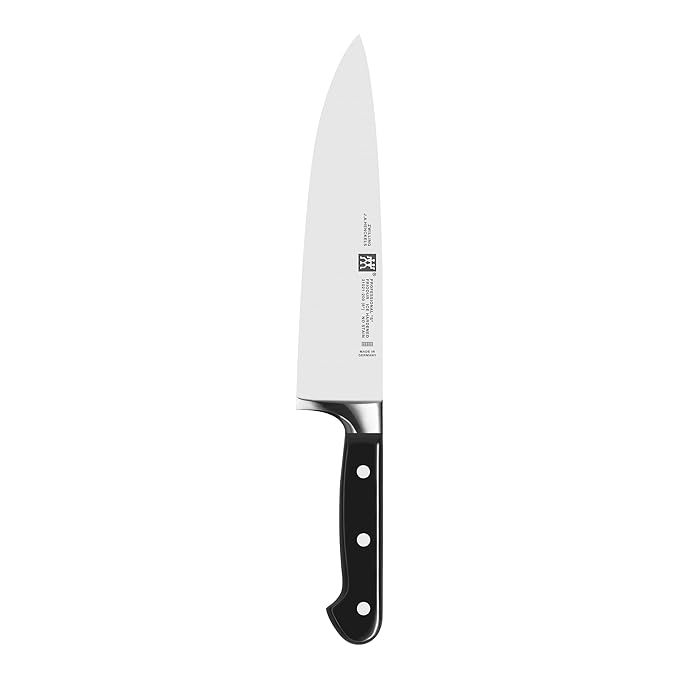
The blade is made from a single piece of special formula steel. ZWILLING calls it their “special formula” steel, and it’s ice-hardened using a process called Friodur. That makes it harder, more flexible, and more resistant to corrosion than standard stainless. The result is a blade that holds its edge longer and feels tougher overall.
The balance point sits right at the bolster, which means the knife feels perfectly centered when you hold it. That’s not something you notice with a cheap knife, but once you’ve felt it with a well-made blade, you can’t unfeel it. Your cuts get easier. Your hand gets less tired.
One detail I genuinely appreciate: the curved blade profile. It allows for a rocking motion that works really well for mincing herbs or garlic. If that’s a technique you use often, this knife will feel like it was made for you. And it practically was.
- Steel: Special formula stainless, Friodur ice-hardened
- Edge angle: 15 degrees per side
- Weight: 8.8 oz
- Handle: Triple-riveted synthetic
- Best for: Cooks who love the German style and want a lifetime knife
Misen 8-Inch Chef Knife – Best Budget Pick That Doesn’t Feel Cheap
Misen took a smart approach. Instead of spending money on fancy branding, they put it into the steel and the grind. The result is a knife that performs way above its price point. If you’re not ready to drop $150+ on a knife yet, Misen is where to start.

The blade is made from AUS-8 steel, which is a Japanese stainless alloy that strikes a good balance between sharpness and toughness. It’s easier to sharpen than harder steels, which is great for beginners. You can maintain this knife with a basic whetstone without a lot of experience.
The geometry is where Misen really stands out. The blade angle is 15 degrees per side, which is sharper than most knives at this price. It ships razor-sharp out of the box. You can use it the moment it arrives and immediately feel the difference from a cheap grocery store knife.
The handle is a bit basic, made from G10 fiberglass. It’s not as warm or beautiful as wood, but it’s durable and comfortable for most hands. Misen is an honest knife. It doesn’t pretend to be something it’s not. For first-time buyers or casual home cooks, it’s genuinely one of the best starting points available.
- Steel: AUS-8 Japanese stainless
- Edge angle: 15 degrees per side
- Weight: 6.9 oz
- Handle: G10 fiberglass
- Best for: Budget-conscious cooks who still want real quality
I hope this guide helps you stop second-guessing and just pick the knife that fits your life. If you cook a lot and want a forever knife, go WÜSTHOF or ZWILLING. Want precision and lightness, try Global or MAC. Love beautiful design with real performance, Shun is hard to beat. On a budget, Misen won’t let you down. There’s a right knife for everyone here.
| Knife | Steel Type | Weight | Edge Angle | Best For |
|---|---|---|---|---|
| WÜSTHOF Classic | High-carbon stainless | 8.5 oz | 14° per side | Heavy daily use |
| Global G-2 | Cromova 18 stainless | 5.9 oz | 15° per side | Light, precise cutting |
| MAC Professional | Molybdenum stainless | 6.5 oz | 15° per side | All-around versatility |
| Shun Classic Blonde | VG-MAX Damascus | 7.3 oz | 16° per side | Beauty + performance |
| ZWILLING Pro S | Friodur ice-hardened | 8.8 oz | 15° per side | Classic German feel |
| Misen 8-inch | AUS-8 Japanese stainless | 6.9 oz | 15° per side | Budget-friendly quality |
Things to Consider Before Buying an 8 Inch Chef Knife: A Real Buyer’s Guide
Buying a chef’s knife sounds simple until you’re standing in front of twenty options with no idea what separates a $30 knife from a $300 one. It’s overwhelming. And most guides don’t actually help, they just list specs without telling you what those specs mean for your cooking.
That’s what this is for. Knowing the right things to consider before buying an 8 inch chef knife can save you from spending money on something that doesn’t fit how you actually cook. So let’s get into what really matters.
Blade Steel: What Your Knife Is Actually Made Of
Not all steel is the same. The type of steel in your blade affects how sharp it gets, how long it stays sharp, and how much babying it needs. German steel is softer, tougher, and easier to maintain. Japanese steel is harder, gets sharper, but chips more easily if you’re rough with it.
Here’s a simple way to think about it. If you’re a casual home cook who tosses the knife around and forgets to dry it sometimes, German steel like the kind in WÜSTHOF or ZWILLING is more forgiving. If you’re careful, patient, and love razor-thin slices, Japanese steel like VG-MAX or Aogami is worth it.
One number to look at is the Rockwell hardness scale, shown as HRC. German knives usually sit around 56-58 HRC. Japanese knives go higher, often 60-65 HRC. Higher means harder and sharper, but also more brittle. Know your habits before you choose.
- German steel: forgiving, easy to sharpen, slightly less sharp
- Japanese steel: incredibly sharp, holds the edge longer, more fragile
- HRC rating matters: higher means sharper but more delicate
- Match steel type to how careful you are in the kitchen
Blade Weight and Balance: How It Feels in Your Hand
A knife that feels perfect for one person can feel like a brick to someone else. Weight and balance are personal. But there are some things worth knowing before you buy without trying.
Heavier knives, usually German-style, do some of the work for you. The weight drives the blade through dense vegetables like butternut squash or thick carrots. Lighter knives, more common in Japanese styles, give you more control and less fatigue during long prep sessions. Neither is wrong. It depends on what you’re cooking and for how long.
Balance point matters too. Pick up a knife and pinch it right at the bolster, where the blade meets the handle. If it balances there, it’s well-made. If it tips heavily to the blade or the handle, you’ll fight the knife instead of letting it work. That fight adds up over a long cooking session.
- Heavier knives help with dense ingredients
- Lighter knives reduce fatigue during long prep
- Test the balance point at the bolster
- Always try to hold a knife before buying if you can
Handle Material and Shape: Comfort Over Everything
The handle is what connects you to the knife. If it’s uncomfortable, you’ll dread using it. That sounds dramatic, but it’s true. A bad handle turns cooking into a chore.
Wood handles look beautiful and feel warm in the hand. But they need more care. They can crack if left wet or put in the dishwasher. Synthetic handles like G10 or pakkawood are more durable and moisture-resistant, which makes them better for everyday use. They’re not as pretty, but they hold up.
Shape matters too. Western handles are wider, rounder, and suit a full-grip style. Japanese wa-handles are octagonal or D-shaped and feel lighter. Neither is wrong, but they suit different grip styles. If you use a pinch grip, where you pinch the blade between your thumb and index finger, a thinner handle usually works better.
- Wood handles: beautiful but need careful maintenance
- Synthetic handles: practical, durable, dishwasher-friendly in most cases
- Western handles suit a full grip
- Japanese handles work well with a pinch grip
Edge Angle: The Hidden Spec That Changes Everything
Most people skip this one. That’s a mistake. The edge angle is the angle at which the blade is sharpened, and it shapes how the knife actually cuts.
German knives typically sharpen at 20-22 degrees per side. Japanese knives go tighter, often 10-15 degrees per side. A lower angle means a sharper, thinner edge that glides through food more easily. But that same thinness makes it more prone to chipping if you hit something hard or use the wrong technique.
Here’s where it gets practical. If you’re sharpening your own knives at home, the edge angle matters because you need to match it when you sharpen. Use a 20-degree angle on a 15-degree Japanese knife and you’re slowly ruining the edge. Some whetstones and sharpeners let you set the angle. Others don’t. Know what you’re buying before you commit.
- German knives: 20-22 degrees, more durable edge
- Japanese knives: 10-15 degrees, sharper but more delicate
- Wrong sharpening angle damages the blade over time
- Look up your knife’s recommended angle before buying a sharpener
Full Tang vs. Partial Tang: Why It Matters for Durability
You’ll see the word “tang” come up a lot. It just means how far the steel extends into the handle. Full tang means the steel runs all the way to the end of the handle. Partial tang means it stops somewhere in the middle.
Full tang knives are stronger, more balanced, and more durable. You can feel the difference. The handle feels solid and heavy. Partial tang knives can still be decent, especially Japanese knives with their traditional wooden handles. But over years of hard use, partial tang knives are more likely to feel loose or wobbly where the handle meets the blade.
For a daily-use 8 inch chef’s knife, full tang is almost always the better call. It tells you that the manufacturer cared about the structure of the knife, not just the surface. And if you ever drop it, a full tang knife will take the hit better without the handle cracking or detaching.
- Full tang: steel runs through the whole handle, stronger and more balanced
- Partial tang: common in traditional Japanese knives, can loosen over time
- Full tang is better for heavy daily use
- Check for visible rivets on the handle as a sign of full tang construction
Maintenance Requirements: Know What You’re Signing Up For
A great knife with zero maintenance becomes a bad knife pretty fast. Before you buy, be honest with yourself about how much upkeep you’ll actually do. Not how much you plan to do. How much you actually will.
High-carbon steel knives get sharper than stainless but rust if you don’t dry them immediately after washing. Stainless steel is more forgiving and resists corrosion. Some Damascus-patterned blades look incredible but need hand-washing every single time without exception. If you know you’ll throw it in the dishwasher sometimes, don’t buy one of those.
Honing and sharpening are two different things. A honing rod realigns the edge between sharpenings. It should happen regularly, ideally before each use. Sharpening actually removes steel to create a new edge. How often you sharpen depends on how hard the steel is. Softer German blades need it more often. Harder Japanese blades hold the edge longer but are trickier to sharpen at home without the right tools.
- High-carbon steel: sharper but needs immediate drying to prevent rust
- Stainless steel: easier to maintain, slightly less sharp
- Honing: realigns the edge, do it often
- Sharpening: removes steel, do it a few times a year depending on use
I hope this breakdown makes your decision a lot clearer. The things to consider before buying an 8 inch chef knife go way beyond the brand name or how it looks in photos. Think about your cooking habits, your grip, your willingness to maintain it. Buy for how you actually cook, not how you wish you did. The right knife will make every meal more enjoyable.
| Factor | What to Look For | Why It Matters | Quick Tip |
|---|---|---|---|
| Blade Steel | German (56-58 HRC) or Japanese (60-65 HRC) | Affects sharpness, edge retention, and fragility | Match steel hardness to your care habits |
| Weight and Balance | 6-9 oz range, balances at the bolster | Affects comfort and control during use | Hold before buying whenever possible |
| Handle Material | Wood, G10, pakkawood, or stainless steel | Affects comfort, grip, and maintenance needs | Synthetic handles suit busy, practical cooks |
| Edge Angle | 10-15° for Japanese, 20-22° for German | Determines sharpness level and how to sharpen | Match sharpener angle to blade spec |
| Tang Construction | Full tang preferred for daily use | Affects strength, balance, and longevity | Look for visible rivets as a full tang sign |
| Maintenance Level | High-carbon needs drying, some need hand-wash only | Determines how long the knife stays in great shape | Be honest about how much upkeep you’ll really do |
Frequently Asked Questions (FAQs)
Is it worth spending over $100 on an 8 inch chef’s knife?
Yes, it really is. A quality knife over $100 uses better steel, holds its edge longer, and feels dramatically better in your hand. You’ll sharpen it less often, cook more comfortably, and make cleaner cuts. Think of it as a long-term investment. A good knife bought once outlasts five cheap knives bought over the same period.
Is it okay to put my chef’s knife in the dishwasher?
For most high-quality knives, no. The heat and detergent in dishwashers break down handle materials, dull the edge, and can cause corrosion on the blade. Especially for Japanese-style knives like Shun or Global, hand washing is a must. Just rinse it, wipe it dry, and it’ll stay in great shape for years.
Can I use an 8 inch chef’s knife to cut through bones?
You shouldn’t. An 8 inch chef’s knife is designed for slicing, dicing, and chopping soft to medium-density ingredients. Bones can chip or crack even a high-quality blade. For bones, use a cleaver or a boning knife instead. Using the right tool for the right job keeps your chef’s knife in peak condition longer.
Can a beginner handle a Japanese-style knife like the MAC or Global?
Absolutely. Just know that Japanese knives are harder and more brittle than German ones, so you need to be a little more careful. Don’t use them to pry open things or cut through frozen food. Treat them with basic respect and they’re just as manageable as any other knife. The sharpness actually makes them easier to use, not harder.
Do I need to sharpen a brand new chef’s knife before using it?
Most quality knives like WÜSTHOF, Shun, and Misen ship sharp and ready to go. You can use them straight out of the box. However, a quick strop on a leather strop or a few passes on a honing rod will align the edge and make that first use feel even better. Sharpening from scratch is something you’ll want to do every few months with regular use.
Do I need a knife block or is a magnetic strip fine?
Both work well, but a magnetic strip is actually better for your blades. Knife blocks can harbor moisture and bacteria, and pulling a knife in and out of a slot can dull the edge over time. A magnetic strip lets the blade rest flat, keeps it dry, and makes it easy to grab quickly. Plus it looks great on your wall.
Is it better to buy a knife set or just one great 8 inch chef’s knife?
One great knife beats a mediocre set every time. Honestly, 80% of kitchen tasks can be handled with just a good chef’s knife and a paring knife. Many sets are padded out with knives you’ll rarely use. Put your budget into one excellent chef’s knife first. Then add pieces as you actually need them.
Can I use a regular honing steel on a Japanese knife like the MAC or Shun?
Not a regular ridged steel, no. Japanese knives use harder steel that can chip on a grooved honing rod. Use a smooth ceramic rod or a leather strop instead. These realign the edge without damaging it. It’s a small difference in technique that makes a huge difference in how long your knife stays sharp.
Is it safe to leave my chef’s knife soaking in water?
Never. Soaking a knife, even briefly, can cause the handle to crack or warp and the blade to rust near the bolster. Even stainless steel isn’t completely immune to moisture damage over time. Always wash your knife quickly with warm soapy water, rinse it, and dry it immediately. That one habit alone will add years to your knife’s life.
Do I need a whetstone to sharpen these knives, or is a pull-through sharpener okay?
A whetstone gives you the best results by far. It removes less steel and gives you more control over the edge angle. That said, pull-through sharpeners are fine for German knives like WÜSTHOF or ZWILLING in a pinch. For Japanese knives, stick to a whetstone or have a professional sharpen them. Pull-through sharpeners can actually damage harder Japanese blades over time.