As an Amazon Associate, I earn from qualifying purchases at no extra cost to you.
6 Best Budget Chef Knives (Buying Guide) 2026
 ByZayyan

Picking a chef knife feels harder than it should. There are hundreds of options, confusing specs, and prices that range from $20 to $500. You just want something that actually cuts well without draining your wallet. In this article I will show you the top 6 best budget chef knives worth every penny right now.


Top 6 Best Budget Chef Knives You Can Buy Now
MAC Knife Professional 8-Inch Chef’s Knife, MTH-80 – Best Overall for Serious Home Cooks
If you’ve ever used a dull knife and wondered why cooking felt like a chore, the MAC MTH-80 will change everything for you. This knife is sharp right out of the box. Not “pretty sharp.” Actually sharp. The kind that glides through a tomato without any pressure at all.
The blade is Japanese steel, sitting at 61 on the Rockwell hardness scale. That means it holds an edge longer than most knives in this price range. MAC also adds hollow dimples along the blade, which stops food from sticking as you slice. That little detail makes a huge difference when you’re cutting potatoes or apples.
The handle feels secure in your hand. It’s got a Western-style grip that most people find comfortable, especially if you’re used to European-style knives. It’s not too heavy, not too light. Just balanced in a way that feels natural after the first few cuts.
At around $155, it’s on the higher end of budget. But honestly, this knife lasts decades with basic care. That makes it cheaper per year than most budget knives you’d replace every two years.
- Blade: Japanese high-carbon steel
- Length: 8 inches
- Best for: Everyday home cooking, precise slicing
- Watch out for: Not dishwasher safe, hand wash only
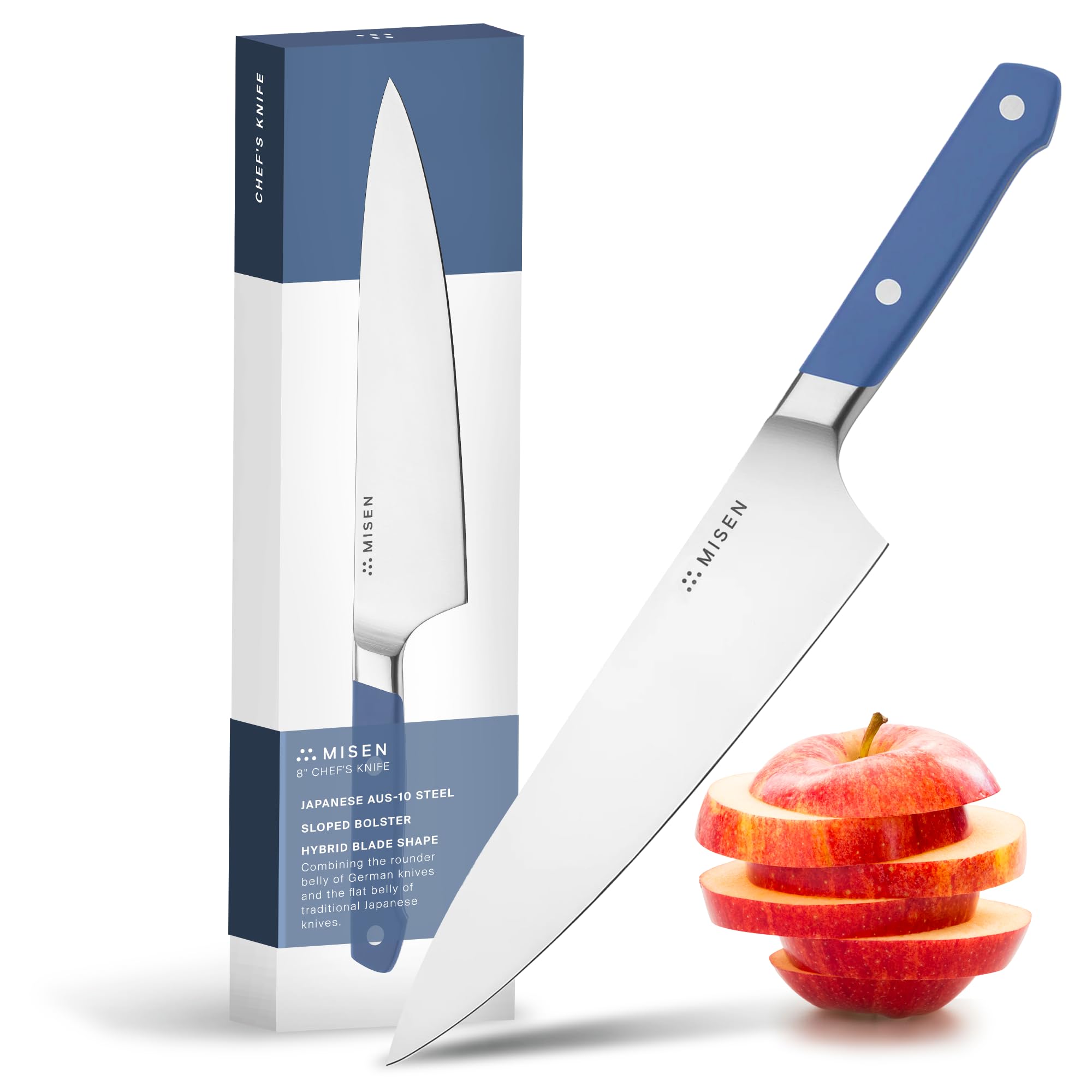
Misen 8-Inch Chef Knife – Best for Beginners Who Want Quality Fast
Misen is a direct-to-consumer brand, so you skip the retailer markup. What you get is a knife that should cost more than it does. Right around $75, this is one of the best deals you’ll find on a chef knife today.
The steel is AUS-8 Japanese stainless, hardened to 58 HRC. That’s solid for this price. The blade angle is 15 degrees per side, which is sharper than most German knives. It means cleaner cuts with less effort, which is exactly what you want when you’re prepping dinner after a long day.
The handle is where Misen really thought things through. It’s a hybrid design, somewhere between Japanese and Western. It fits a wide grip comfortably and doesn’t cause fatigue if you’re chopping for 20-30 minutes straight. That matters more than most people realize until they’ve experienced hand cramp from a bad handle.
One thing to know: the Misen isn’t quite as refined as the MAC. But at half the price, that’s expected. For someone just building their kitchen kit, this is honestly where I’d start.
- Blade: AUS-8 Japanese stainless steel
- Length: 8 inches
- Best for: Beginners, budget-conscious cooks
- Watch out for: Edge may need sharpening sooner than pricier options
ZWILLING Professional S 8-Inch Chef’s Knife – Best German Knife for Heavy-Duty Use
ZWILLING has been making knives since 1731. That’s not a typo. They know what they’re doing. The Professional S is their workhorse, and it shows in how it’s built.
The blade is forged from a single piece of high-carbon stainless steel. It goes through a special ice-hardening process that makes it harder, more flexible, and more resistant to staining than typical German knives. The edge holds up well, and the steel is tough enough to handle bones and thick cuts without chipping.
The handle is triple-riveted with a full bolster. That bolster adds weight right at the balance point, which gives the knife a very “planted” feel when you’re cutting. Some people love that. If you’re used to lighter Japanese knives, it takes a minute to adjust.
At around $100-$120, it’s priced fairly for what you’re getting. This is the knife you hand down to your kids. It’s built to last, and ZWILLING’s reputation backs that up completely.
- Blade: High-carbon stainless steel, ice-hardened
- Length: 8 inches
- Best for: Heavy prep work, durability seekers
- Watch out for: Heavier than Japanese knives, not for everyone
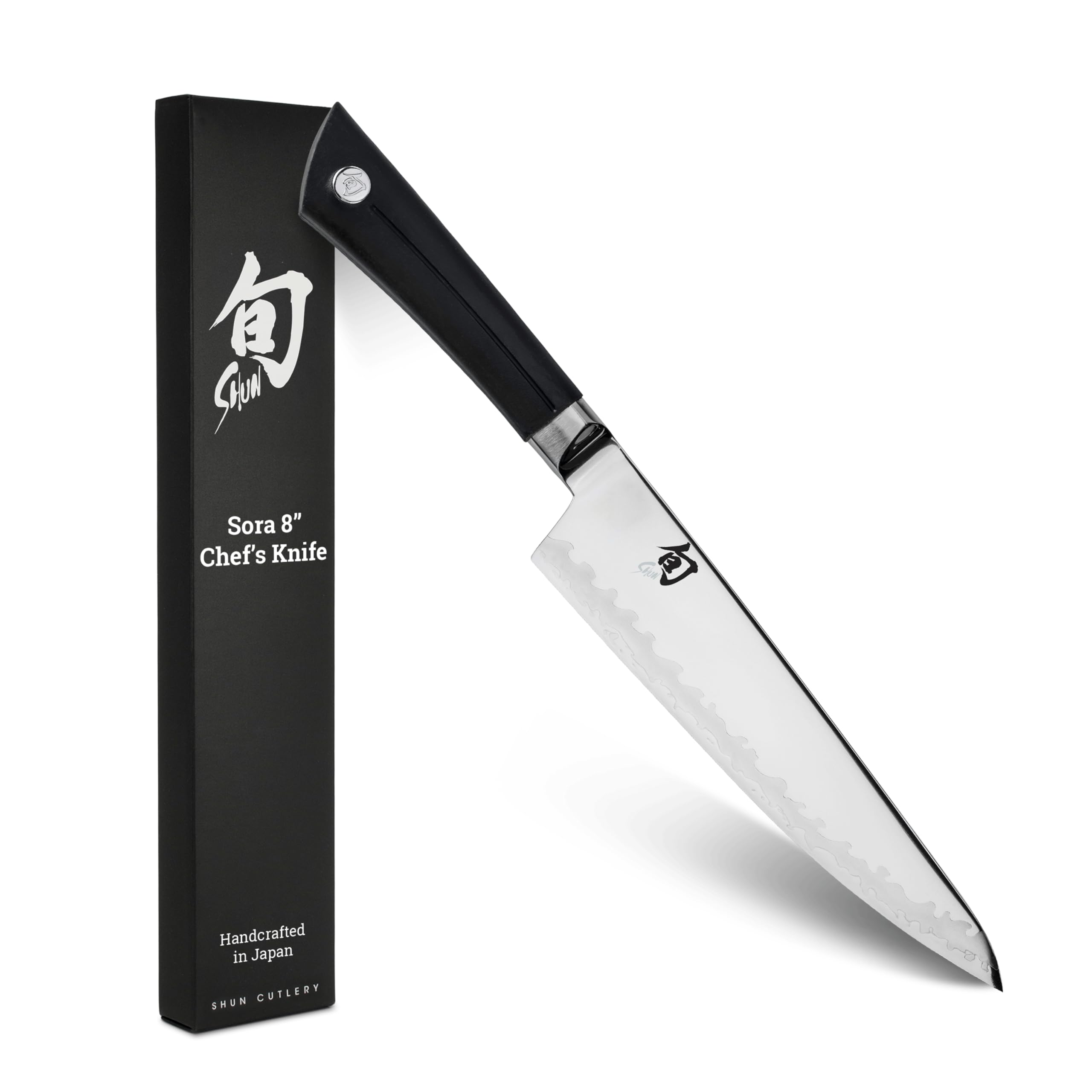
Shun Sora 8-Inch Chef’s Knife – Best Japanese-Style Knife for Beautiful Cuts
Shun makes knives that look as good as they perform. The Sora is their entry-level line, but don’t let that fool you. This is still a serious knife made with real Japanese craftsmanship.
The blade uses a composite construction, VG10 steel on the cutting edge layered with a san mai stainless cladding. VG10 is the same steel used in much more expensive Shun knives. It gets incredibly sharp and stays that way. The edge angle is 16 degrees per side, which gives you precision cuts on vegetables and proteins alike.
The handle is a traditional Japanese D-shape. If you haven’t used one before, it takes a short adjustment period. But once you do, it feels very controlled. Your thumb and index finger naturally find a solid grip point. Less fatigue, more control.
This knife runs around $100-$130 depending on where you buy it. For that price, you’re getting genuine Japanese craftsmanship and steel quality that competes with knives twice the cost.
- Blade: VG10 cutting edge with stainless cladding
- Length: 8 inches
- Best for: Precise vegetable work, Japanese cooking style
- Watch out for: D-handle isn’t for everyone, especially lefties
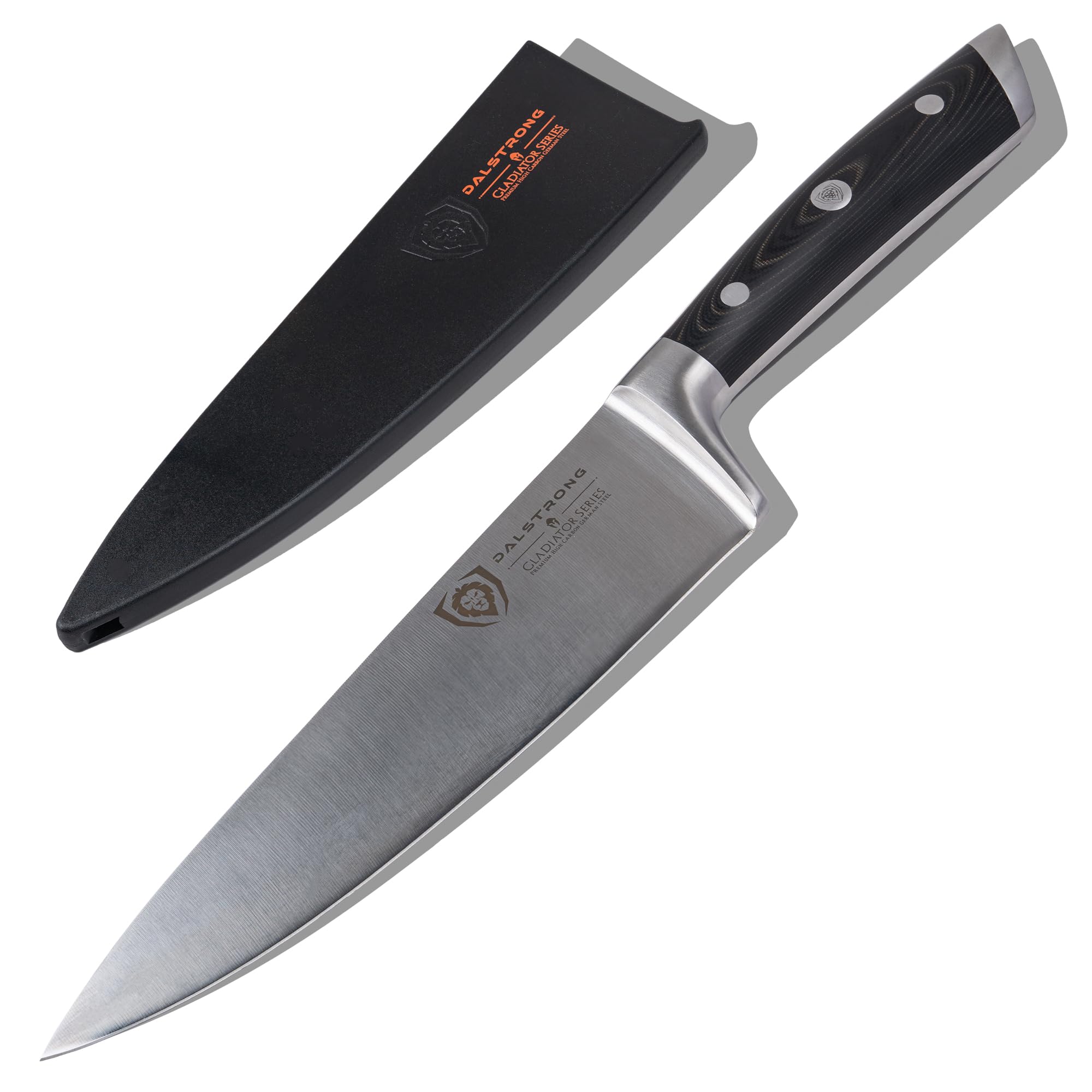
Dalstrong 8-Inch Chef Knife (Gladiator Series) – Best-Looking Knife That Actually Performs
Dalstrong gets a lot of attention for how their knives look. And yeah, they look amazing. But here’s the honest truth: the Gladiator Series also cuts really well, especially for its price point around $60-$80.
The blade is ThyssenKrupp German steel, hardened to 56 HRC. That’s softer than Japanese steel, which means it’s more forgiving if you accidentally hit a bone or cut on a hard surface. It’s easier to sharpen too, which is great if you’re new to knife maintenance.
The handle is triple-riveted with a full bolster and a comfortable grip that works for most hand sizes. It’s got a satisfying heft to it. You feel like you’re holding something real, not a toy. That psychological factor actually helps when you’re cooking.
Where Dalstrong sometimes gets criticism is consistency in quality control. Most people love their knives. But occasionally someone gets one that’s not perfectly aligned. Still, at this price, the value is hard to argue with, and their customer service is responsive if something goes wrong.
- Blade: ThyssenKrupp German high-carbon stainless steel
- Length: 8 inches
- Best for: Visual appeal, beginner to intermediate cooks
- Watch out for: Occasional quality control variation
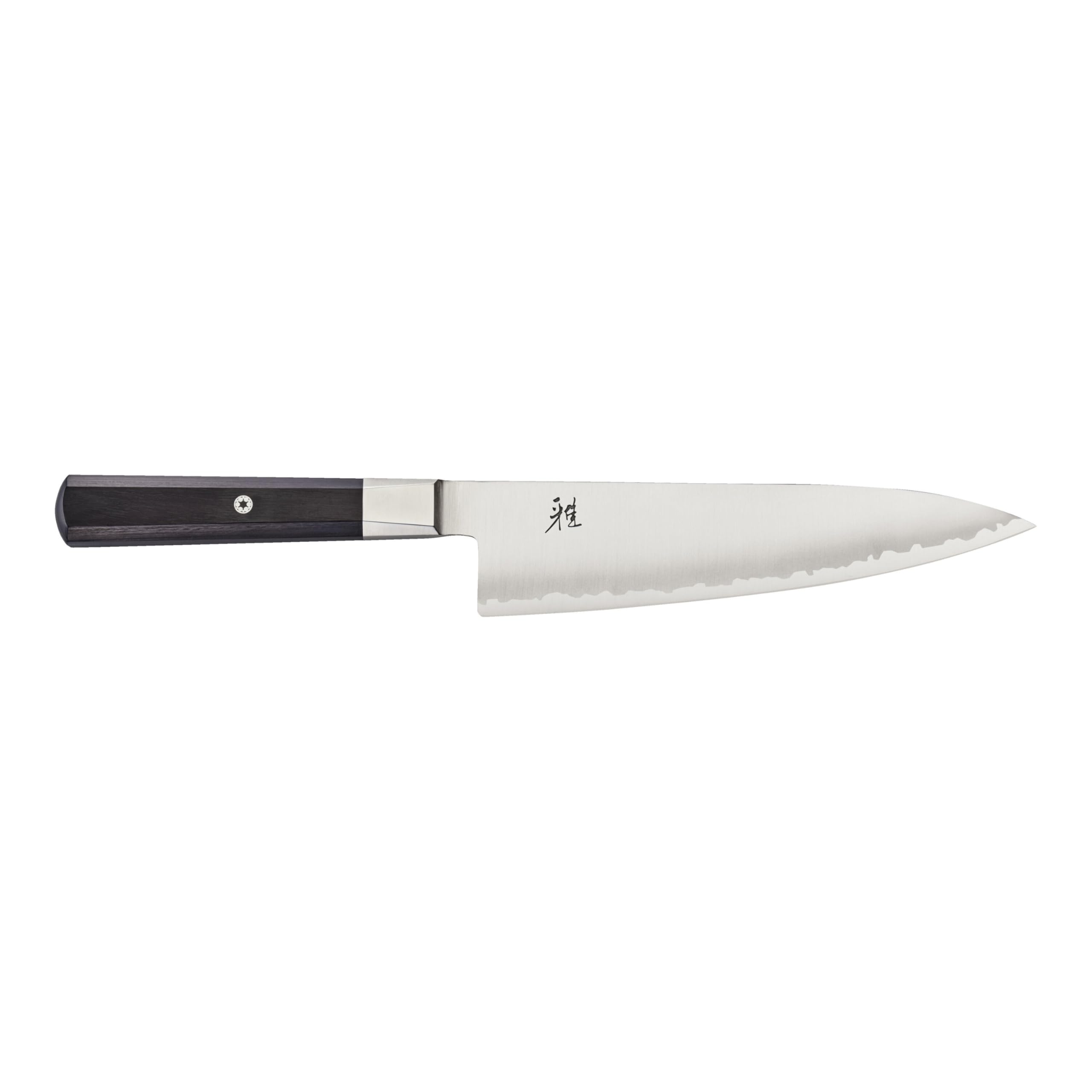
Miyabi Koh 8-Inch Chef’s Knife – Best Premium Budget Pick for Knife Enthusiasts
Miyabi is owned by ZWILLING but made in Japan. That combination gives you the engineering precision of a German company with the blade tradition of Japanese craftspeople. The Koh is the most expensive on this list at around $150-$180, but it earns every dollar.
The steel is FC61 fine carbide, hardened to 61 HRC. That’s on par with much more expensive Japanese knives. The edge angle is 9-12 degrees per side, which is razor sharp. Thinner than a credit card. You’ll feel the difference the first time you slice a scallion.
The handle is a Western-style octagonal shape made from Pakkawood. It’s comfortable, grippy even when wet, and looks stunning. The knife is also lighter than it looks, with a balance point right at the bolster that makes it feel like an extension of your hand.
If you’re serious about cooking and you want one knife that does everything beautifully, the Miyabi Koh is the pick. It’s not cheap, but within the “budget premium” range, nothing comes close to this level of refinement.
- Blade: FC61 fine carbide steel, 61 HRC
- Length: 8 inches
- Best for: Knife enthusiasts, gifting, serious home chefs
- Watch out for: Harder steel can chip if used on bones
I hope this guide makes your decision a whole lot easier. Every knife here is worth buying, but the right one depends on you. Are you a beginner? Go with Misen. Want something built to last forever? ZWILLING. Looking for the sharpest edge at a fair price? Miyabi Koh. Pick based on how you actually cook, not just what looks good in photos.
| Knife | Price Range | Steel Type | Best For |
|---|---|---|---|
| MAC Professional MTH-80 | ~$155 | Japanese high-carbon | Overall best, precision slicing |
| Misen Chef Knife | ~$75 | AUS-8 Japanese stainless | Beginners, everyday cooking |
| ZWILLING Professional S | ~$100-$120 | German high-carbon, ice-hardened | Heavy-duty use, durability |
| Shun Sora | ~$100-$130 | VG10 with stainless cladding | Japanese-style, precise cuts |
| Dalstrong Gladiator | ~$60-$80 | ThyssenKrupp German steel | Value pick, visual appeal |
| Miyabi Koh | ~$150-$180 | FC61 fine carbide | Enthusiasts, premium sharpness |
Things to Consider Before Buying a Budget Chef Knife (Complete Guide 2026)
Buying a chef knife sounds simple until you’re staring at 40 options on Amazon with no idea what half the specs even mean. Steel type, blade angle, HRC rating, full tang… it’s a lot. And when you’re trying to keep the price reasonable, one wrong pick can leave you with a knife that dulls in a month.
These things to consider before buying a budget chef knife will save you from that frustration. Because a good knife makes cooking genuinely easier. And you don’t need to spend $300 to get one.
Blade Steel: It Decides How Long Your Edge Lasts
The steel type is the single biggest thing that affects how your knife performs over time. Most budget knives use either German steel or Japanese steel. German steel is softer, tougher, and easier to sharpen at home. Japanese steel is harder, holds an edge longer, but chips more easily if you’re rough with it.
For everyday home cooking, German steel is very forgiving. You can cut on a slightly imperfect surface, hit a bit of bone, and it won’t ruin the blade. Japanese steel rewards careful use. If you’re precise in the kitchen, it’s worth the extra attention.
Look for high-carbon stainless steel no matter which style you choose. Pure stainless without carbon rusts less but dulls fast. High-carbon stainless gives you the best of both. AUS-8, VG10, and ThyssenKrupp are all solid steel types you’ll see in this price range.
- German steel: tough, forgiving, easy to maintain
- Japanese steel: sharper edge, longer retention, needs more care
- High-carbon stainless: the sweet spot for budget knives
- Avoid: knives that don’t list the steel type at all
Blade Hardness (HRC Rating): The Number That Actually Matters
HRC stands for Rockwell Hardness Scale. It tells you how hard the steel is. Most budget chef knives fall between 56 and 61 HRC. That range matters more than most people realize when they’re buying their first serious knife.
A knife rated 56-58 HRC is softer. It dulls a bit faster but bends instead of chips. Great if you cook daily and sharpen often. A knife at 60-62 HRC stays sharp much longer but is more brittle. Drop it on a tile floor and you might chip the tip.
Think about how you actually cook. If you’re aggressive in the kitchen, bash garlic with the flat of the blade, or sometimes forget to use a proper cutting board, go with the lower HRC range. If you’re careful and deliberate, go higher.
- 56-58 HRC: softer, more flexible, easier to sharpen
- 60-62 HRC: harder, sharper longer, more chip-prone
- Best for beginners: 58 HRC is a sweet spot
- Avoid: anything below 55 HRC, it won’t hold an edge at all
Handle Comfort: You’ll Feel This After 20 Minutes of Chopping
A handle that looks great in photos can make your hand cramp after 15 minutes of real cooking. That’s not an exaggeration. Bad handle design causes fatigue, reduces control, and honestly makes you hate cooking. So pay close attention to this before buying.
There are two main handle shapes: Western and Japanese. Western handles are rounded and symmetrical. They work for everyone, left or right-handed. Japanese D-shape handles fit the right hand really well but can feel awkward for lefties. If you’re left-handed, double check before buying.
Material matters too. Pakkawood is a great budget handle material, grippy even when wet. Plastic handles are fine but can get slippery. Avoid handles with sharp edges or visible seams where the handle meets the blade. That gap collects bacteria and can loosen over time.
- Western handles: symmetrical, works for all hand sizes
- D-shape handles: great for righties, tricky for lefties
- Best material: Pakkawood or textured composite
- Avoid: smooth plastic handles with no grip texture
Full Tang vs. Half Tang: One of These Is a Deal Breaker
Tang refers to how far the blade steel extends into the handle. A full tang knife has steel running all the way through the handle, usually visible along the spine. A half tang or rat-tail tang only extends partway in. This difference affects how long your knife lasts.
Full tang knives feel balanced. The weight is distributed evenly between the blade and handle. That balance makes cutting easier and more controlled. Half tang knives often feel handle-heavy or blade-heavy. They also have a weak point where the metal ends inside the handle, and that’s where they eventually break.
At a budget price point, some brands cut costs with half tang construction. Always check the product description before buying. If it doesn’t mention full tang, look at the photos. You should see metal rivets along the handle or visible steel running through it.
- Full tang: balanced, durable, the right choice
- Half tang: weaker, unbalanced, breaks over time
- How to check: look for rivets or visible steel in handle photos
- Avoid: any knife that doesn’t specify tang construction
Blade Length and Weight: Match It to How You Actually Cook
Most chef knives come in 6, 8, or 10-inch options. Eight inches is the sweet spot for most home cooks. It’s long enough for big vegetables like butternut squash or cabbage, but not so long that it feels unmanageable on a small cutting board.
Weight is personal. Some people love a heavier knife because it feels powerful and does some of the work for you. Others prefer a lighter knife for speed and control, especially during long prep sessions. There’s no right answer here. It really depends on your style.
If you’ve never thought about it before, go with a medium-weight 8-inch knife. That covers almost every task in a home kitchen, from mincing herbs to slicing a roast chicken. You can always adjust later once you know what you prefer.
- 6-inch: great for small hands or small prep tasks
- 8-inch: the all-around best choice for most people
- 10-inch: great for big cuts, awkward on small boards
- Avoid: going too heavy if you cook for long stretches
Brand Reputation and Warranty: Don’t Skip This Step
Budget doesn’t mean throwaway. A good budget knife brand stands behind their product. Look for brands that offer at least a limited lifetime warranty or a clear return policy. That tells you they’re confident in what they’re selling.
Brands like MAC, Misen, ZWILLING, and Shun have real track records. They’ve been around long enough to build a reputation, and they answer customer complaints. Newer brands with flashy marketing but zero history are a gamble. Some turn out great. Some don’t, and you’re stuck with a $70 paperweight.
Read real reviews, not just the star rating. Look for mentions of long-term use, how the edge holds up after six months, and how the company responded to problems. That tells you way more than a polished product description ever will.
- Look for: lifetime or limited warranty from the brand
- Check: how the brand handles complaints and returns
- Trusted names: MAC, ZWILLING, Shun, Misen, Miyabi
- Avoid: brands with no reviews older than 6 months
I hope these things to consider before buying a budget chef knife help you feel confident walking into that decision. You don’t need to be a chef to pick the right knife. You just need to know what to look for. A little research now saves you from buying the same knife twice.
| What to Check | Why It Matters | What to Look For | What to Avoid |
|---|---|---|---|
| Steel Type | Affects sharpness and durability | AUS-8, VG10, or high-carbon stainless | Knives with no steel type listed |
| HRC Rating | Determines edge hardness and chip resistance | 58-61 HRC for most home cooks | Anything below 55 HRC |
| Handle Shape | Affects comfort and control during long prep | Pakkawood or textured composite grip | Smooth plastic with no texture |
| Tang Construction | Determines balance and long-term durability | Full tang with visible rivets | Half tang or unspecified tang |
| Blade Length | Affects versatility and ease of use | 8 inches for most tasks | 10-inch if your board is small |
| Brand and Warranty | Shows confidence in product quality | Brands with real customer history | New brands with no long-term reviews |
Frequently Asked Questions (FAQs)
Is it worth spending more on a chef knife?
Yes, absolutely. A better knife makes cooking faster, safer, and honestly more enjoyable. Cheap knives dull quickly, which means you push harder, and that’s when accidents happen. Spending $75 to $150 on a quality knife that lasts 10 to 20 years is genuinely one of the smartest kitchen investments you can make.
Is it okay to put these knives in the dishwasher?
No, please don’t. Even knives that say “dishwasher safe” suffer from it. The heat and harsh detergent dull the edge fast and can loosen the handle over time. Just rinse your knife with warm water right after use, dry it with a towel, and store it properly. That’s really all it takes.
Can I use a budget chef knife for professional cooking?
You can, yes. Plenty of line cooks and culinary students use knives in the $75 to $150 range every single day. What matters more than price is keeping the edge sharp and using proper technique. A $100 knife that’s well maintained will outperform a $300 knife that’s never been sharpened.
Can a beginner sharpen these knives at home?
Yes, and you should learn how. A honing rod keeps the edge aligned between sharpenings. For actual sharpening, a whetstone takes some practice but gives the best results. If that sounds like too much, pull-through sharpeners work fine for casual home cooks. Just avoid cheap electric sharpeners that remove too much metal.
Do I really need an 8-inch chef knife?
For most people, yes. An 8-inch knife handles almost every kitchen task, from mincing garlic to breaking down a whole chicken. If you have very small hands or a tiny cutting board, a 6-inch might feel better. But 8 inches is the sweet spot for versatility, and all six knives on this list are exactly that size.
Is it safe to use a sharp knife as a beginner?
This sounds backwards, but a sharp knife is actually safer than a dull one. Dull knives slip off food because they can’t bite in cleanly. That’s when you cut yourself. A sharp knife does what you tell it to do. Just keep your fingers curled in a “claw” grip while cutting and you’ll be fine from day one.
Can I use these knives on a glass or ceramic cutting board?
Please don’t. Glass and ceramic boards will wreck even the best knife edge after a few uses. Stick with wood or plastic boards. Wood is gentler on the blade and naturally antimicrobial. Plastic is easy to sanitize. Either one is a much better choice and your knife will stay sharper for way longer.
Do I need to buy a knife set or is one good knife enough?
One good knife is honestly enough for most people. A quality 8-inch chef knife handles 90% of kitchen tasks. You can always add a paring knife and a bread knife later, but start with one great chef knife first. Knife sets often include knives you’ll never use and skimp on the ones that actually matter.
Is the Miyabi Koh really worth the higher price?
If you love cooking and you want a knife that feels truly special, yes. The Miyabi Koh is the sharpest knife on this list and the most refined. But if you’re a casual cook making dinner a few nights a week, the Misen or MAC will serve you just as well and save you $50 to $100. Know your own cooking habits before deciding.
Can these knives handle cutting meat and fish?
Yes, all six knives on this list handle meat and fish well. For boneless cuts, all of them are excellent. If you’re breaking down whole chickens or cutting through thick cartilage, go with the ZWILLING for its toughness. Avoid using any of these on frozen food or actual bone, as that can chip or damage even hard Japanese steel.