As an Amazon Associate, I earn from qualifying purchases at no extra cost to you.
6 Best Food Processors for Baking (Buying Guide) 2026
 ByZayyan

Baking is already a lot of work. The last thing you need is a weak machine that gives up halfway through your pie dough. Finding the right food processor feels overwhelming, especially with so many options out there. In this article I will show you the top 6 best food processors for baking, so you can stop guessing and start baking better.




Top 6 Best Food Processors for Baking You Can Buy Now
Cuisinart 14-Cup Food Processor – Best All-Around Baker’s Pick
If you bake regularly, the Cuisinart DFP-14BCNY is probably the most dependable machine you’ll find at this price point. It has a 720-watt motor, which sounds modest, but it handles pie crust dough, cookie dough, and even bread dough without breaking a sweat. The 14-cup bowl gives you plenty of room to work with bigger batches, so you’re not stuck dividing your dough in half just to fit it in.
The build feels solid. Brushed stainless steel exterior, a tight-fitting lid, and a feed tube wide enough to drop in a whole block of butter without pre-cutting it. That matters when you’re making pastry and you want cold butter to stay cold. Every second counts with flaky dough.
Cleanup is easy too. The bowl, lid, and blades are all dishwasher safe. After a long baking session, that’s not a small thing. You don’t want to spend 20 minutes scrubbing dough off plastic ridges.
One thing to watch out for: the plastic bowl can pick up stains from things like beets or carrots if you use it for savory prep too. Nothing that affects performance, but worth knowing if you care about looks.
- 720-watt motor
- 14-cup capacity bowl
- Dishwasher-safe parts
- Wide feed tube for whole ingredients
- Brushed stainless exterior
- Great for pie crust, cookie dough, pastry
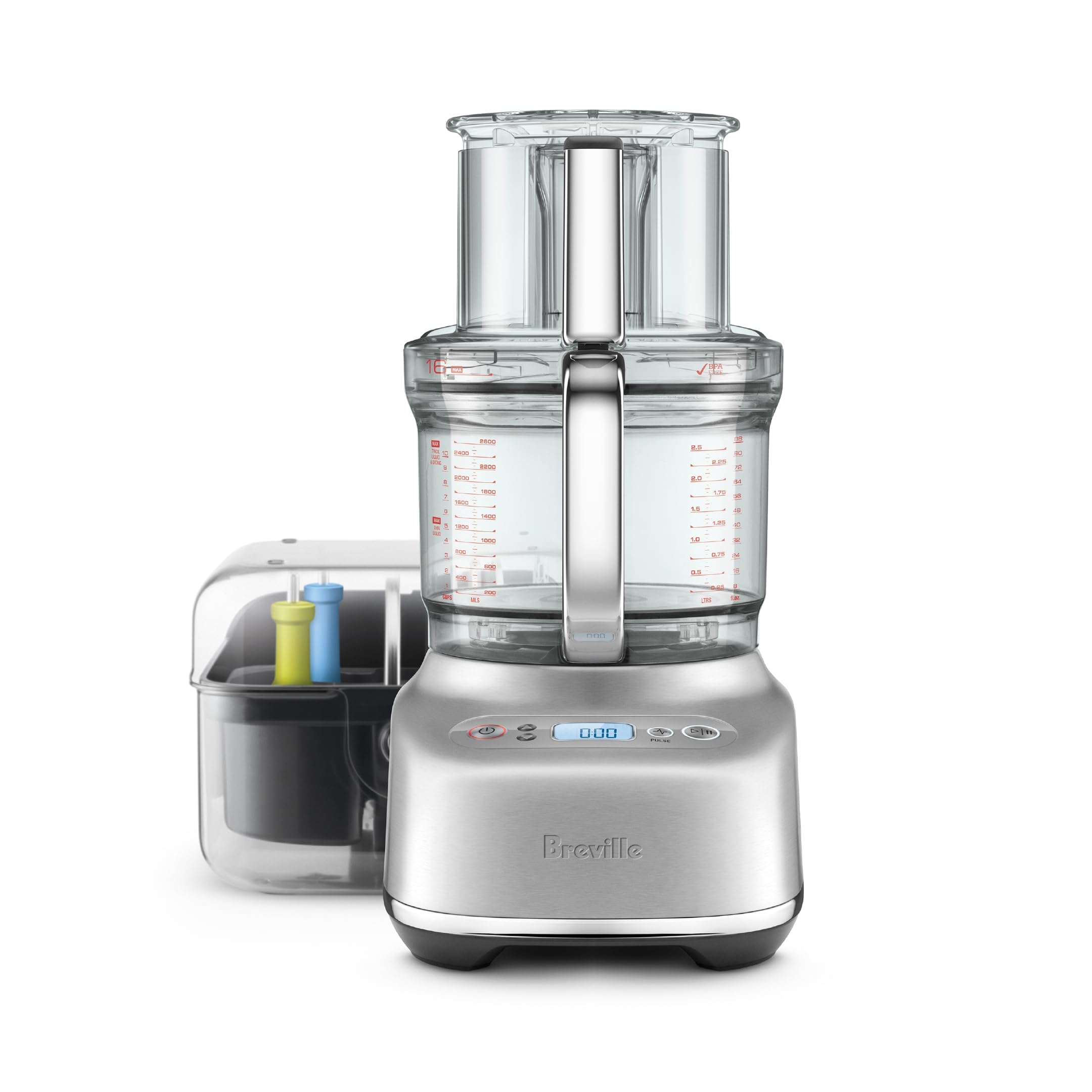
Breville BFP810 Sous Chef 16 Cup Food Processor – Best for Serious Bakers
The Breville Sous Chef is what a serious baker reaches for. The 1200-watt motor is powerful enough to make short work of stiff bread dough, and the 16-cup bowl means you can process full double batches without stopping. If you bake for a family or sell baked goods, this extra capacity makes a real difference in your workflow.
What sets this machine apart is the variable slicing disc. You can adjust it from 0.3mm to 8mm thickness, which is useful when you need uniform slices of fruits for tarts or thin cuts for layered pastries. Most food processors give you one fixed thickness. Breville gives you 24 settings.
It also comes with both a large 16-cup bowl and a smaller 2.5-cup bowl for smaller tasks. So if you just need to quickly chop a handful of nuts for a topping, you switch to the small bowl and save yourself the cleanup of the big one. Smart design.
The price is higher than most. But if you bake three or four times a week, you’ll feel the difference every single time you use it. Built to last, quiet for its power level, and precise in a way that budget processors simply aren’t.
- 1200-watt motor
- 16-cup large bowl plus 2.5-cup mini bowl
- 24-position adjustable slicing disc
- Handles stiff bread dough easily
- Good for big batches and double recipes
- Quieter than you’d expect for the wattage
KitchenAid 13-Cup Food Processor – Best for KitchenAid Fans
KitchenAid built a reputation with their stand mixers, and the KFP1318CU food processor carries that same energy. It’s a 13-cup machine with a 400-watt motor, which is plenty for most everyday baking tasks. Pie dough, shortbread, tart shells, muffin batters. It handles all of them well without any drama.
The design is clean and matches KitchenAid’s iconic look perfectly. If you already have a KitchenAid mixer on your counter, this processor will look like it belongs there. That sounds like a shallow reason to buy something, but kitchen aesthetics actually matter to a lot of home bakers. When your space looks put-together, you enjoy using it more.
The ExactSlice system lets you adjust slice thickness from the outside of the machine while it’s running. That’s a nice touch when you’re slicing apples for a tart and you want to go thicker or thinner without stopping the machine entirely.
One honest note: 400 watts is on the lower end. It works fine for most baking, but if you’re making very stiff dough or processing large amounts of dense ingredients, it can slow down or strain a little. For light-to-medium baking loads, though, it’s a confident performer.
- 400-watt motor
- 13-cup bowl capacity
- ExactSlice external thickness control
- Dishwasher-safe removable parts
- Matches KitchenAid stand mixer aesthetic
- Good for everyday baking tasks
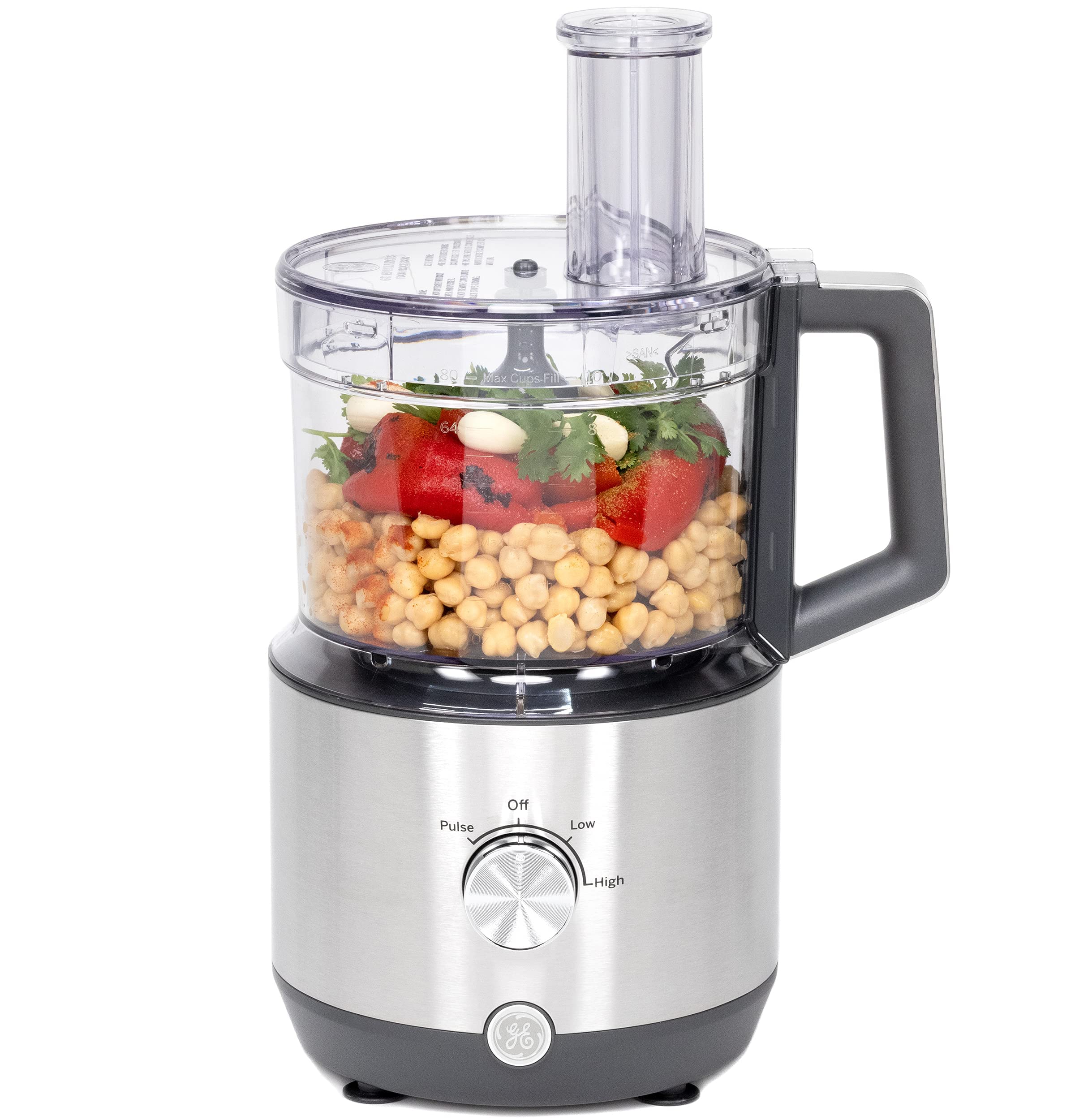
GE 12 Cup Food Processor – Best Budget Pick for Bakers
Don’t let the price fool you. The GE 12-cup food processor does more than you’d expect for what it costs. It has a 550-watt motor, which puts it comfortably above many budget options. It can handle cookie dough, crumb crusts, chopped nuts, and soft bread dough without any fuss.
The ergonomic handle on the bowl makes it easier to lift and pour. Sounds like a small thing, but when you’re transferring a full bowl of dough to a pan, a good handle matters. The stainless steel blades stay sharp over time, and the machine is compact enough to fit under most kitchen cabinets without having to adjust shelves.
It comes with a chopping blade, reversible shredding disc, and slicing disc. That’s a solid accessory set for baking. You can slice fruit for a galette, shred cheese for a savory tart, or blitz crackers into crumbs for a cheesecake base, all with the same machine.
If you bake once or twice a week and you don’t want to spend a lot, this is your machine. It won’t replace a Breville, but it also doesn’t cost nearly as much. For casual bakers, the GE hits a sweet spot between performance and price that’s hard to beat.
- 550-watt motor
- 12-cup bowl with ergonomic handle
- Reversible shredding disc included
- Compact design fits under cabinets
- BPA-free parts
- Great value for occasional bakers
Oster Blender and Food Processor – Best 2-in-1 for Small Kitchens
Space is real. Not everyone has a counter big enough for a separate blender and food processor. The Oster combo machine solves that problem directly. It works as both a blender and a food processor, so you get two functions in one footprint. For bakers in small apartments or compact kitchens, that matters a lot.
The food processor bowl holds up to 5 cups, which works for small-batch baking. Think single pie crusts, one batch of cookies, or a quick tart shell. It won’t handle double batches or big bread doughs, but for one person or a couple, it covers the basics well.
The blades are BPA-free, and all the removable parts go in the dishwasher. The motor is not the strongest you’ll find, but for the tasks it’s designed for, it does the job. It also comes at a price that won’t hurt your wallet if you’re just getting started with food processors.
One thing to be clear about: this isn’t a machine for heavy-duty baking. It’s built for convenience and versatility, not raw power. But if you need a machine that blends your morning smoothie and helps you make a pie crust on the weekend, the Oster handles both without taking up two spots on your counter.
- Blender and food processor combo
- 5-cup food processor capacity
- BPA-free, dishwasher-safe parts
- Compact footprint
- Affordable price point
- Best for small batches and limited counter space
Braun 12 Cup Food Processor – Best for Precision Baking Tasks
Braun doesn’t get talked about as much as Cuisinart or KitchenAid, but this machine earns its spot on the list. The 12-cup food processor has a 600-watt motor and German engineering behind it, which shows in how consistently it performs. Even after months of use, it maintains the same speed and power output without degrading.
For baking, the precision matters most in tasks like uniform slicing and fine chopping. Braun’s slicing disc produces really consistent cuts, which is something you’ll notice when making layered cakes, fruit tarts, or anything where thickness consistency actually changes the final result. Uneven slices bake unevenly. Simple as that.
It also comes with a dedicated chopper attachment, which is great for quickly processing nuts, chocolate, or dried fruit to fold into batters. You don’t have to use the big bowl for a small task. Just switch to the chopper and get it done in seconds.
The machine is designed to be easy to assemble and disassemble. No confusing locking mechanisms or fiddly attachments. Everything clicks into place intuitively, which you’ll appreciate mid-recipe when your hands are already covered in flour and you just need the machine to cooperate.
- 600-watt motor
- 12-cup bowl capacity
- German engineering for consistent performance
- Precision slicing disc for uniform cuts
- Dedicated chopper attachment included
- Easy assembly and disassembly
I hope this guide saves you time and helps you pick the right machine for your kitchen. If you bake often and need power, go with the Breville. On a budget? The GE or Oster won’t let you down. For everyday baking, the Cuisinart is hard to beat. Match the machine to how you actually bake, not to the most impressive spec sheet, and you’ll be happy with whatever you choose.
| Product | Motor | Capacity | Best For | Price Range |
|---|---|---|---|---|
| Cuisinart DFP-14BCNY | 720W | 14 Cup | All-around baking | Mid-range |
| Breville BFP810 Sous Chef | 1200W | 16 Cup | Heavy-duty, big batches | Premium |
| KitchenAid KFP1318CU | 400W | 13 Cup | Light to medium baking | Mid-range |
| GE 12 Cup | 550W | 12 Cup | Budget-friendly casual baking | Budget |
| Oster Blender & Processor | Combo | 5 Cup | Small kitchens, 2-in-1 use | Budget |
| Braun 12 Cup | 600W | 12 Cup | Precision tasks, consistent results | Mid-range |
Things to Consider Before Buying a Food Processor for Baking: A Complete Guide
Buying a food processor feels simple until you’re standing in front of ten different options and have no idea which one actually fits your kitchen. You second-guess the size, the wattage, the price. It gets confusing fast.
Knowing the right things to consider before buying a food processor for baking saves you from spending money on a machine that frustrates you every single time you use it. Here’s what actually matters.
Bowl Size and Capacity
The bowl size decides how much you can process in one go. Get this wrong and you’ll spend your whole baking session splitting dough into smaller batches. That wastes time and messes up your recipe consistency.
A 7-cup bowl works fine if you mostly bake for yourself or one other person. But if you regularly make double batches of cookie dough or a full pie crust, you want at least a 11 to 14-cup bowl. More room means more freedom.
Watch out for machines that advertise a large capacity but have a narrow bowl. A wide, low bowl processes dough more evenly than a tall, narrow one. Shape matters just as much as the number on the box.
- 7-cup: good for single servings and small batches
- 11 to 14-cup: best for regular home baking
- 16-cup: ideal for big batches or baking for a crowd
- Check bowl shape, not just the size number
Motor Wattage and Power
Wattage tells you how hard the motor can work. For baking, this matters more than almost anything else. Pie dough is thick. Bread dough is stiff. A weak motor either struggles or burns out over time.
For general baking, you want at least 600 to 700 watts. That covers pie crust, shortbread, cookie dough, and crumb toppings without any strain. If you plan to make stiffer doughs like some bread doughs, go for 900 watts or higher.
Don’t just trust the watt number on the box either. Some machines list peak wattage, which is the max the motor can hit for a split second, not what it runs at consistently. Look for reviews that mention sustained performance under load.
- 400 to 500W: fine for light tasks only
- 600 to 700W: solid for everyday baking
- 900W and above: handles stiff doughs and big batches
- Look for consistent wattage, not just peak ratings
Blade and Disc Quality
The blades do the actual work. A dull or flimsy blade gives you uneven results, and in baking, uneven processing shows up directly in your final product. Pie crust with uneven butter pieces won’t bake the same across the whole pastry.
The standard S-blade handles most baking tasks well. Chopping nuts, blending butter into flour, making dough, it covers all of it. But also check if the machine includes a slicing disc and a shredding disc. Those help when you’re making fruit tarts or savory bakes with cheese.
Stainless steel blades hold their edge much longer than plastic or coated ones. And always check how the blade attaches. Some designs make it easy to lift out after processing. Others practically require a degree to disassemble. Simple is better.
- S-blade is essential for dough and chopping
- Stainless steel stays sharp longer than coated blades
- Slicing and shredding discs add useful versatility
- Easy blade removal saves you time and frustration
Ease of Cleaning
Nobody wants to spend 20 minutes scrubbing a food processor after baking. If a machine is hard to clean, you’ll start avoiding it. That defeats the whole purpose of buying it.
Check how many separate parts the machine has. More parts mean more cleaning. Ideally, the bowl, lid, and blades should all be dishwasher safe. Most decent machines offer this, but always confirm before buying because some lids warp in the dishwasher.
Also look at the design of the bowl itself. Bowls with lots of ridges, sharp corners, or tiny grooves trap dough and fat. A smooth interior wipes down in seconds. Dough stuck in a corner groove takes real effort to remove, especially once it dries.
- Fewer parts means less cleanup
- Confirm dishwasher safety for bowl, lid, and blades separately
- Smooth bowl interiors are easier to clean than ridged ones
- Avoid designs with tight grooves where dough can hide
Safety Features and Locking Mechanism
A food processor deals with sharp blades spinning at high speed. Safety matters. Most machines won’t start unless the bowl and lid are locked in place, which is the minimum you should expect from any machine you buy.
Some machines have a more secure locking system than others. Twist-lock designs tend to feel more reliable than simple press-fit lids. If the lid shifts slightly during heavy processing, it can trip the safety sensor and stop the machine mid-batch. Annoying and disruptive.
Also check if the feed tube has a safe pusher included. When you add ingredients while the machine runs, you need a proper pusher, not your fingers. Sounds obvious, but cheaper machines sometimes include a flimsy one that barely fits the tube.
- Machine should not start without bowl and lid locked
- Twist-lock lids feel more secure than press-fit designs
- Feed tube pusher should fit properly and feel solid
- Non-slip base keeps the machine stable during heavy processing
Noise Level and Build Quality
A food processor running at full power is loud. But some machines are noticeably louder than others, and if you bake early in the morning or have kids napping nearby, this actually affects your daily life. It’s worth paying attention to.
Higher wattage motors tend to run louder, but the housing design plays a big role too. Machines with heavy, solid bodies dampen vibration better than lightweight plastic ones. A machine that rattles and vibrates across the counter is not just annoying, it also wears out faster.
Build quality also shows in the small things. Sturdy buttons that don’t feel cheap. A bowl that sits tight without wobbling. A cord long enough to reach your outlet without pulling the machine to the edge of the counter. These small details matter more over years of use than they do in the store.
- Heavy bodies dampen vibration and reduce noise
- Plastic housing tends to rattle more than reinforced designs
- Check cord length before buying
- Sturdy buttons and a tight-fitting bowl signal good overall build
I hope these things to consider before buying a food processor for baking help you cut through the confusion and pick a machine you’ll actually enjoy using. Match your choice to how you bake, your batch sizes, and your kitchen setup. The right processor makes baking faster, easier, and a lot more fun.
| What to Check | Why It Matters | What to Look For | Watch Out For |
|---|---|---|---|
| Bowl Capacity | Determines batch size | 11 to 14 cups for most home bakers | Narrow bowls that process unevenly |
| Motor Wattage | Drives dough and heavy tasks | 600W minimum, 900W+ for stiff doughs | Peak wattage listed instead of sustained |
| Blade Quality | Affects texture and consistency | Stainless steel S-blade included | Coated blades that dull quickly |
| Cleaning Ease | Impacts how often you use it | Dishwasher-safe bowl, lid, and blades | Ridged bowls with dough-trapping grooves |
| Safety Features | Protects you during operation | Twist-lock lid, proper feed tube pusher | Flimsy press-fit lids that trip mid-use |
| Noise and Build | Affects daily comfort and longevity | Heavy body, non-slip base, solid buttons | Lightweight plastic housing that rattles |
Frequently Asked Questions (FAQs)
Is it worth buying a food processor just for baking?
Yes, absolutely. A food processor saves you serious time on tasks like making pie dough, chopping nuts, and pulsing butter into flour. Doing these things by hand is possible, but it takes longer and often gives less consistent results. If you bake even once or twice a week, a food processor pays for itself pretty quickly in time saved and better results.
Is it okay to make bread dough in a food processor?
Yes, you can. Food processors actually work great for certain bread doughs, especially quick breads and no-knead style doughs. The key is not to over-process. Pulse in short bursts until the dough just comes together. For yeast breads with long kneading needs, a stand mixer is still a better fit, but for quick doughs, the food processor is fast and effective.
Can I use a food processor to cream butter and sugar for cakes?
You can, but it’s not the ideal tool for that job. A food processor can blend butter and sugar together, but it doesn’t aerate the mixture the way a hand mixer or stand mixer does. Creaming butter and sugar properly means whipping in air, which gives cakes their light texture. For that specific step, stick to a mixer. Use the food processor for everything else.
Can a food processor replace a stand mixer for baking?
For some tasks, yes. Pie crusts, crumb toppings, chopping, slicing, and even some cookie doughs work great in a food processor. But for tasks that need aeration, like creaming, whipping cream, or beating egg whites, a stand mixer does a better job. Think of them as different tools for different jobs. Having both is ideal, but if you had to choose one for general baking, the stand mixer edges it out.
Do I need a large-capacity food processor for baking?
It depends on how much you bake at once. If you regularly make double batches or bake for a crowd, a 12 to 16-cup bowl makes sense. For solo bakers or couples who bake small batches, a 7 to 9-cup machine covers most needs. Going too small means you’re constantly splitting batches. Going too big means you have a machine that’s harder to store and clean for small everyday tasks.
Do I need to chill my food processor bowl before making pastry dough?
Yes, if you want the best results. Cold tools keep butter cold, and cold butter is what creates flaky pastry. Pop your bowl and blade in the freezer for about 15 minutes before you start. It makes a noticeable difference in the texture of pie crusts and puff pastry. This is a small step that professional pastry cooks swear by, and once you try it, you’ll understand why.
Is it safe to process hot ingredients in a food processor?
No, don’t do it. Processing hot liquids or very hot food in a food processor is risky. The heat builds up pressure inside the sealed bowl, which can cause the lid to blow off or crack. Always let hot ingredients cool down to at least room temperature before adding them to the food processor bowl. For things like hot custard or cooked fruit fillings, patience here actually protects your machine and your safety.
Can I use a food processor to make croissant or laminated dough?
Not really. Laminated doughs like croissant or puff pastry need precise folding and layering of butter between dough sheets. A food processor can’t do that. It can help you mix the initial dough, but the actual lamination process is done by hand or with a sheeter. If you’re getting into laminated pastry, learn the hand technique. The food processor just isn’t the right tool for that specific job.
Do I need special blades for baking tasks?
You don’t need anything exotic. The standard S-blade that comes with most food processors handles 90% of baking tasks, including dough, crumb crusts, and chopping. A slicing disc is helpful for fruit tarts or layered desserts. A shredding disc is great for cheese-based savory bakes. Most machines come with these three, and that’s genuinely all you need for a full range of baking projects.
Is it better to pulse or run the food processor continuously when making dough?
Pulse. Always pulse for dough. Running it continuously can over-develop the gluten in the dough, making it tough instead of tender. Pulsing gives you control. You can stop the moment the dough comes together and avoid overworking it. This is especially true for pie crust, where a few extra seconds of processing can mean the difference between flaky and dense. Short pulses, check often, stop early.